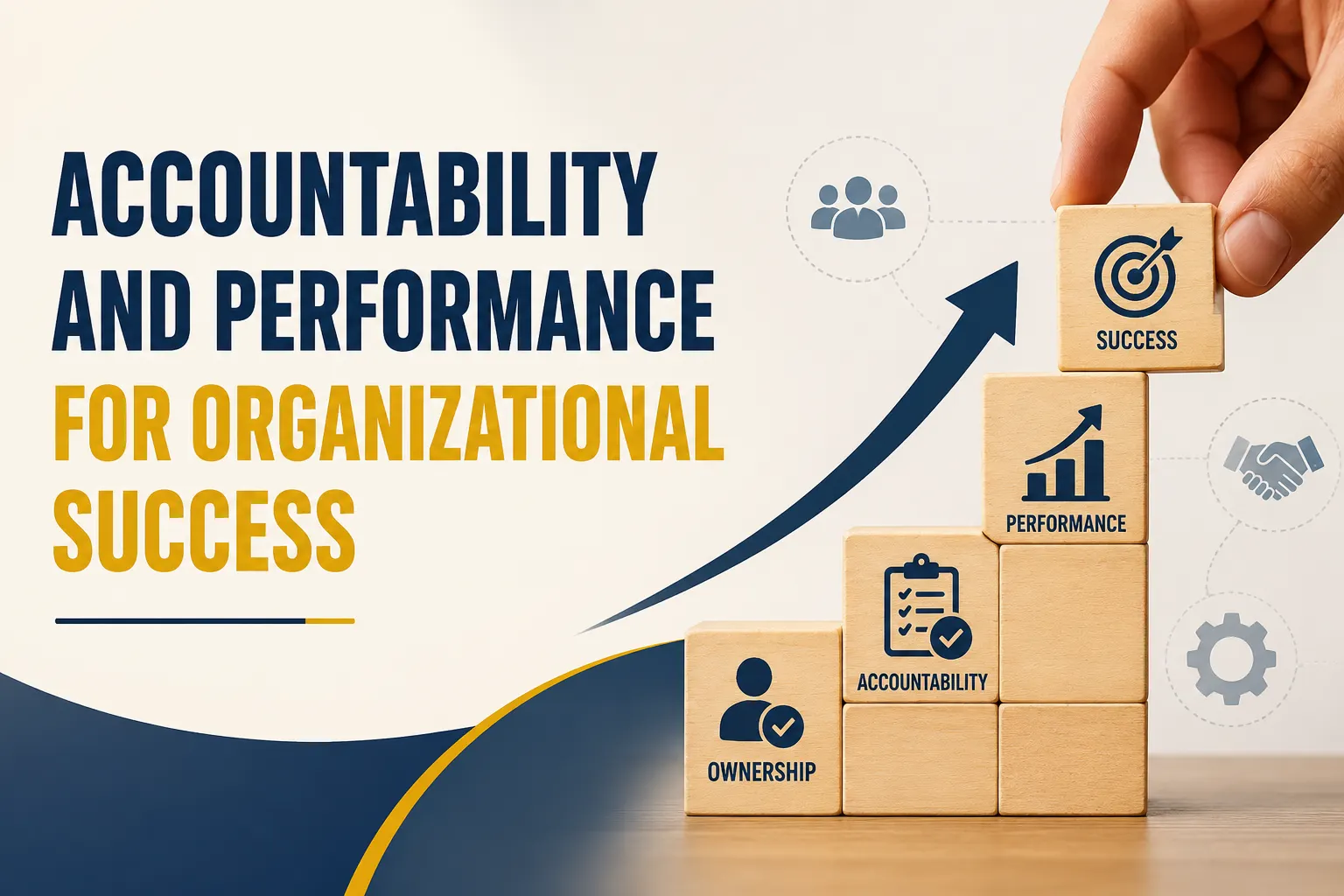




How Senior Leaders Can Drive Team Accountability Without Compromising Trust
The accountability gap prevails in many Indian firms today, camouflaged by patience, understanding, or culture. But avoiding accountability does not protect trust. It quietly destroys it.
There is a conversation most senior leaders know they should have, and quietly avoid.
The team member fails to meet a deadline. The commitment is not fulfilled. There is a decline in performance from what was expected. The leader is aware. The entire team is aware. And yet the discussion does not take place. Not for lack of being aware, but for a fear of harming a relationship that has taken many months or even years to cultivate.
This is the accountability gap that prevails in many Indian firms today. And there is no discrimination based on industry type or firm size here. It is prevalent in boardrooms as well as in business units, camouflaged by patience, understanding, or culture.
The truth is, avoiding accountability does not protect trust. It quietly destroys it.
If you are a senior leader trying to understand why your team's performance plateaus despite your best intentions, the answer often lives here, in the space between the standard you set and the consequence you were unwilling to enforce.
The Real Reason Senior Leaders Avoid Accountability
Before addressing how to build accountability, it is worth being honest about why leaders avoid accountability conversations in the first place.
In the case of an Indian work setting, there are many reasons why this is especially hard. One factor is hierarchy and the assumption that the leader will command respect and not conflict. The other reason is the long history of association with coworkers with whom one has risen through the ranks. Finally, there is the issue of maintaining harmony.
But the avoidance runs deeper than culture. It runs into identity.
Many senior managers fear appearing hard on an individual for being accountable since they believe it may make them seem too tough, distant, and unapproachable to their team members. The senior managers do not understand what accountability is all about and equate it with punishment.
This is the central misunderstanding that undermines leadership accountability and trust simultaneously. Accountability, done right, does not damage trust. The absence of it does.
In a scenario where a leader constantly ignores poor performance within a group, there are three effects:
- 1 Top performers become resentful.
- 2 Average performers feel at ease.
- 3 People begin to set new standards in place of the existing ones.
That statistic should give every senior leader pause. Disengagement is not a motivation problem. It is often an accountability problem wearing a different label.
Reframing What Accountability Actually Means
The most important shift a senior leader can make is this: stop treating accountability as a reactive tool and start treating it as a structural one.
Accountability in the workplace is not about catching people when they fall short. It is about building a system clear enough that falling short becomes the exception, not the norm.
That is, instead of waiting until there is an appraisal period or until the situation escalates into a crisis to begin the process of accountability, it is about ensuring that your style of leadership incorporates clear expectations, consequences, and standards before there is any need for concern regarding performance.
When accountability is structural, it stops feeling personal. The leader is not reacting to a person. They are upholding a system that everyone agreed to operate within.
The Three Pillars of Accountability That Preserve Trust
Building performance accountability at work that does not compromise trust requires consistency across three areas. Miss any one of them, and the entire system weakens.
Clarity of Expectation
Accountability does not begin when someone falls short. It begins the moment you define what success looks like.
One of the most common reasons for which senior executives face difficulty in enforcing accountability is because of vagueness in expectations. Arbitrary enforcement of rules always feels personal.
Clear expectations are specific, measurable, and documented. They answer three questions unambiguously: What does good performance look like? By when? And what does it mean if the standard is not met?
This translates to abandoning such vague directives as "be more proactive," "improve client communication," and "take more ownership." Rather than asking for better pipeline management, we say "all client communications to be documented within 24 hours, with action items identified by the end of that same day."
Specificity is not micromanagement. It is respect. It tells your team members exactly what they are being held to, removes interpretation, and gives them a fair opportunity to succeed.
Consistency of Enforcement
The worst mistake that a top leader can make when trying to foster an accountability culture within their organization is to use the standards selectively. There is nothing worse for team morale than seeing how a star employee avoids the same penalty that his or her colleague has to pay.
Leaders who consistently practice accountability get 32% better results from their teams.
Center for Creative LeadershipThe problem with selective enforcement is the implicit message that says that outcomes justify actions and results matter more than the process of getting the results. In the end, this creates an organizational culture where it is the unwritten code of conduct that matters more than the written one. To be consistent takes courage. It means applying the same standards to the best people on the team that you have.
This is where leadership accountability and trust are most directly connected. Trust is not built through warmth alone. It is built through predictability. When your team knows that your word carries equal weight for everyone, they believe in the system you are leading.
Consequences Decided in Advance
One of the most overlooked aspects of holding employees accountable is the preparation that happens before the conversation. Specifically, knowing what the consequence will be before the standard is ever missed.
Many leaders announce a standard without deciding what they are actually willing to enforce. When the moment arrives, they improvise. Improvisation in high-stakes moments almost always defaults to avoidance.
The rule is that, prior to establishing an expectation, one should establish the consequence for failing to meet that expectation. This must be done not as a threat but rather as an inherent process within the functioning of the team. A good way of doing this is by means of a progressively applied model.
When consequences are defined in advance and communicated transparently, enforcement feels procedural rather than punitive. The leader is not reacting in frustration. They are maintaining the integrity of a system that exists to protect everyone's interests, including the team members'.
Why Accountability Conversations Do Not Have to Feel Confrontational
A significant reason why leaders avoid accountability conversations is the assumption that they will be adversarial. The person on the receiving end will become defensive, disengaged, or resentful.
This assumption is worth examining because it is largely incorrect when the conversation is handled well.
Effective accountability discussions share three qualities:
Behaviour, not personality
An identified standard, not impressions
Assist the individual, not punish the failure
It makes quite a difference whether one says "You haven't been meeting expectations" or "This was an agreed standard, and that is where I see a discrepancy. I would like to understand why this is happening and how I can help."
Leaders who deal with performance accountability through a coaching approach: being inquisitive, not accusatory; concrete, not vague; future-oriented, not past-oriented, are likely to discover that this conversation enhances the relationship rather than putting stress on it.
The team member leaves knowing exactly where they stand, what is expected, and that their leader is invested in their success. That is not damage to the relationship. That is the foundation of a stronger one.
Building an Accountability Culture That Outlasts Individual Leaders
The ultimate aim for any senior leader is not just to hold individuals accountable. It is to build an accountability culture in organizations that sustains itself.
This happens when accountability becomes a shared norm rather than a top-down enforcement mechanism:
Peers hold each other to commitments.
Teams self-correct before a leader has to intervene.
High performance is a collective standard, not just an individual achievement.
Leaders model the behaviour they expect from others.
Getting there requires senior leaders to model the behavior they expect. This means acknowledging when they themselves have missed a commitment. It means being transparent about the standards they are held to by their own leadership. It means treating leadership accountability and trust not as a one-way street, flowing downward from leader to team, but as a mutual contract.
When senior leaders demonstrate that accountability applies to them as well, something important shifts in the organizational culture. Accountability stops being something that is done to people and starts being something the organization does together.
The Standard You Enforce Is the Culture You Create
Accountability in the workplace is not a leadership style. It is a leadership decision, made repeatedly, consistently, and often in moments of discomfort.
The senior leaders who get this right are not the ones who are hardest on their teams. They are the ones who are clearest with them. They define expectations precisely, enforce them consistently, and hold those conversations with the same professionalism they bring to every other aspect of their role.
Trust is not built through the absence of accountability. It is built through the presence of it, applied fairly, communicated honestly, and sustained over time.
The gap between the leader your team needs and the leader they currently experience is rarely a gap in capability. It is almost always a consistency gap.
Close that gap, and you do not just improve performance. You build the kind of trust that makes high performance possible in the first place.
Ready to Build a High-Accountability Culture?
Blanchard India helps senior leaders develop the skills to lead with clarity, consistency, and trust. Explore our leadership development programmes.
Explore Programmes Talk to an Expert