



Table of Contents
Most leaders believe their teams speak freely. Most teams would privately disagree. That gap is where psychological safety lives or doesn’t. Here is what actually closes it.
Somewhere in your last all-hands or leadership review, at least one person in the room knew something that would have improved the decision on the table. They had the information. They probably had a sharper read on the risk than whoever was presenting. They said nothing and the meeting ended with unanimous agreement.
That is not a communication problem. It is not a culture fit problem. It is not about the individual. It is about what the room, over months or years, had quietly taught everyone in it: that speaking up here costs more than it returns.
That cost has a name. The absence of psychological safety at work the shared, experienced belief that honest input will not be punished is one of the most expensive invisible losses any organisation carries. It shows up in errors that surface six months too late. In talent that resigns without a real explanation. In strategies that fail at execution because the flaw was visible inside the room but nobody said so when it still mattered.
The concept is everywhere now. Leadership offsites, engagement decks, HR town halls everyone is talking about it. Very few organisations are doing anything durable to build it, which is the part that tends not to get said directly. The distance between knowing about psychological safety and actually changing how the room behaves is precisely where the commercial damage accumulates.
What Is Psychological Safety at Work?
Amy Edmondson’s research at Harvard Business School puts this precisely: psychological safety is a shared belief among team members that the team is safe for interpersonal risk-taking. Two words in that definition do most of the work. Shared meaning this is a collective condition, not a character trait belonging to the one brave person who speaks up regardless of consequences. And interpersonal risk meaning the stakes are social, not technical.
What people are actually calculating, before they decide whether to open their mouth, is whether honesty here has career consequences. Whether the manager who flagged the delivery risk last quarter got quietly passed over, or got thanked. Whether the person who said ‘I think this direction is wrong’ became a cautionary reference point in hallway conversations, or whether the organisation’s course actually changed. Teams absorb those outcomes and update their behaviour accordingly. In a room with low psychological safety, the information that most needs to reach leadership is exactly the information that never does.
There is a persistent misconception worth naming directly: psychological safety is not about comfort. It has nothing to do with removing friction, softening performance expectations, or tiptoeing around feedback because someone might feel bad. That version of the concept – and it circulates widely – produces the opposite of what the research describes. Teams with genuine psychological safety in the workplace typically have higher performance standards and more direct accountability conversations than teams without it. They can afford to, because problems reach the surface early enough to be addressed rather than quietly buried until they become expensive.
Why Psychological Safety in the Workplace Matters More Than You Think
Google’s Project Aristotle set out to identify what separated their highest-performing teams from the rest. The researchers examined credentials, individual intelligence, team composition, technical ability every variable the organisation’s analytical capacity could surface. The strongest predictor of team effectiveness was none of those things. It was whether the team had psychological safety. Not the talent in the room. The environment those people shared.
The downstream effects are specific and measurable. Teams with genuine psychological safety in the workplace raise problems while they are still cheap to fix – not six months after the window for course-correction has closed. They share rough ideas before those ideas are polished into defensible presentations, which means the organisation actually benefits from the thinking that happens early rather than only from what gets packaged for approval. They admit errors quickly, which reduces compounding costs. And they retain the professionals who are most in demand elsewhere, because talented people choose environments where being honest does not feel like a calculated risk.
In India’s mid-market, replacing a single manager-level professional costs between ₹3 and ₹10 lakhs once recruitment, onboarding, the productivity gap, and lost institutional knowledge are factored in. That number scales quickly across a function. Low psychological safety in the workplace drives the disengagement and quiet attrition that generates those costs year after year – in organisations that never connect the two because the mechanism is invisible.
There is a pattern that regularly confuses senior leadership: why some teams with demonstrably stronger credentials consistently underperform teams that look less impressive on paper. The explanation is almost always environmental. Solid performers operating in a high-trust room outperform exceptional performers operating in fear. That is not a motivational observation. It is what the data keeps showing, industry after industry, study after study.
Read More: Influencing Skills Course: Empowering Leadership Without Authority
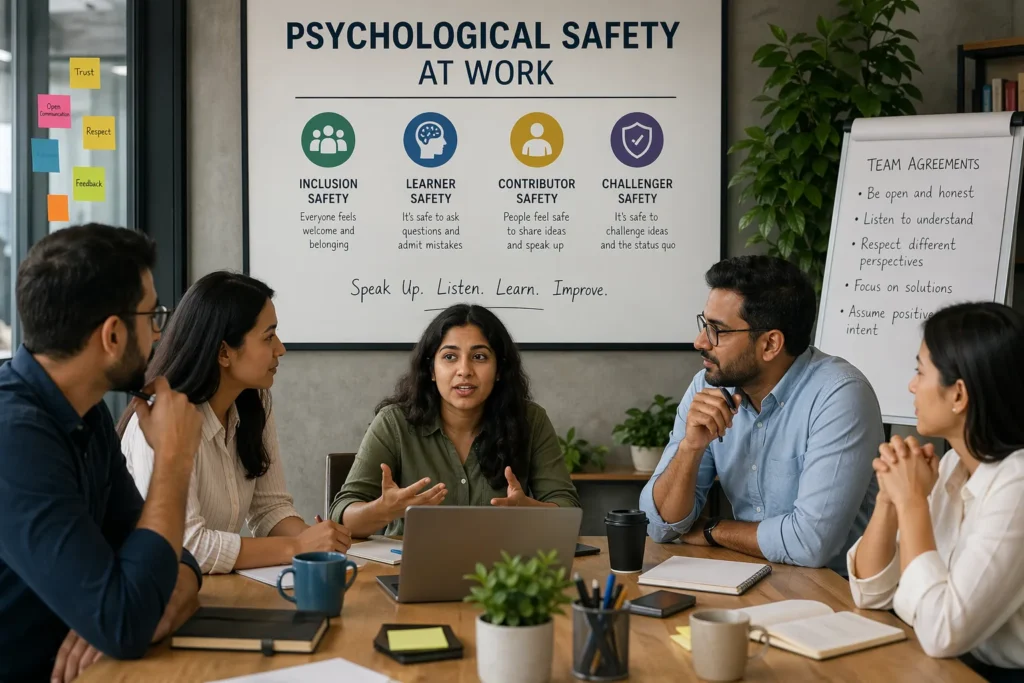
The Four Stages of Psychological Safety
Timothy Clark’s model for how psychological safety develops inside teams is most useful as a diagnostic it does not just describe the end state, it tells you where your team is right now, why it is stuck there, and what specifically has to shift. The progression holds whether you are leading a five-person startup team or a sprawling enterprise function.
Stage 1: Inclusion Safety: The Foundation Everything Else Requires
Before anyone can learn visibly, contribute meaningfully, or challenge constructively, they need to feel that they actually belong in the group. Not tolerated. Not on informal probation pending proof of value. Actually welcome as a legitimate member.
When this stage is absent, people burn through cognitive and emotional energy managing their status rather than doing their work. Am I actually wanted here? Does what I say register? That internal calculation is exhausting and it happens before the first agenda item is reached. New hires who feel dumped into the deep end and judged by how fast they figure everything out alone are in a team without Inclusion Safety. Professionals from different backgrounds who have a seat at the table but no real influence on the direction of the conversation are in a team without Inclusion Safety.
Leaders typically assume this stage is established during onboarding and then permanent. It is not. It requires active maintenance as team composition changes, as hierarchies shift, and as different voices compete for attention. When it erodes and it erodes quietly every stage built on top of it begins to erode with it.
Stage 2: Learner Safety: Where Most Professional Cultures Get Stuck
In organisations where professional standing depends on projecting certainty always having the answer, never visibly not knowing something Learner Safety collapses. People stop asking the questions that reveal gaps. They stop admitting confusion. They stop trying things that might not work, because failure here becomes the lens through which colleagues assess their competence going forward.
Learner Safety means people feel safe to learn out in the open. A senior director saying ‘I have no idea how that works walk me through it and nobody blinks. That is what it looks like when this stage is actually present. Teams with genuine learner Safety grow continuously, because real learning the kind that changes how people work demands the freedom to be wrong in front of others, and people need first-hand evidence from inside this specific team to believe that being wrong here is safe.
Stage 3: Contributor Safety: Where Business Impact Becomes Visible
At this stage, people feel safe offering their actual thinking to the shared work. Not just completing tasks. Not just passing information along a chain. Their judgment, their perspective, their disagreement with an existing plan. They believe based on direct experience inside this team, not from a values statement that the group genuinely wants to hear it.
This is where psychological safety starts delivering measurable performance results. Ideas reach the surface while they are still rough and improvable, rather than after they have been sanitised into something safe to present. People flag problems with approved plans when they see a real issue. A team operating at Stage 3 is producing more of its actual available intelligence, and that difference shows up in outcomes.
Stage 4: Challenger Safety: The Hardest Stage, and the Most Powerful
At Stage 4, people feel genuinely safe to challenge the way things are done. To question an existing strategy in the room where that strategy was decided. To push back on authority when the moment calls for it. To say, clearly, ‘I think we are getting this wrong’ and have that land as a valued contribution rather than a career-limiting move.
This stage asks something very specific of leaders. Not whether you say you value honest challenge. Whether you can sit with the discomfort of being challenged right now, in front of your team, when someone contradicts your decision and you have to decide in real time how to respond. Leaders who become even subtly defensive in those moments, who gradually give less airtime to the people who push back, destroy Challenger Safety while simultaneously giving speeches about how much they value candour. The organisations that establish this stage can genuinely adapt because the people inside them are equipped to surface what is actually happening, not just what the hierarchy wants to hear. Crucial Conversations® for Mastery is specifically designed to build the skills that make those moments possible.
Signs That Psychological Safety at Work Is Missing
Before you can build psychological safety at work, you have to recognise what its absence actually looks like in your own organisation. And here’s what makes this tricky low psychological safety almost never shows up as something dramatic or obvious. It hides inside patterns that are easy to misread as personality dynamics, team chemistry, or just “how things are.” But these are environmental signals. Learning to see them clearly is where the work begins.
Pay attention to meetings where the same three or four people always talk and the rest stay quiet. When psychological safety at work is low, participation narrows to whoever navigates the social dynamics of that room most comfortably. The quiet ones? They’re rarely disengaged. Many of them are among the most observant and thoughtful people in the room. They’ve simply done the mental maths and concluded: speaking up here is not worth the risk. Psychological Safety in the Workplace rewires that calculation it makes speaking up not only safe but visibly valued.
Pay attention to how the team responds after something goes wrong. When the first instinct is to figure out whose fault it was rather than what happened and why, that reflex is actively corroding psychological safety. The lesson people absorb is immediate and permanent: mistakes are dangerous here. Hide them. Minimize them. Pass the blame sideways before it sticks to you. Psychological Safety in the Workplace requires and this isn’t optional that failure is treated as data to learn from, not as evidence of someone’s inadequacy.
And pay attention to the quality of agreement you see. When everybody enthusiastically nods along with whatever the highest-ranking person says, that is not alignment. That’s compliance manufactured by low psychological safety. Real psychological safety at work looks like the opposite – honest pushback, genuine questions, actual debate about things that matter. If your leadership team hasn’t had a genuinely uncomfortable conversation in the past month, that quiet isn’t peace. It’s a warning sign. Take it seriously.
Read More: Mastering Core Leadership Skills: A Guide to Building Effective Leadership
How to Build Psychological Safety in the Workplace: Practical Examples
Here’s where most organisations hit a wall. They understand the concept. They can identify the symptoms of its absence. They might even know which of the four stages their team is stuck at. But translating all of that awareness into actual, sustained behavioural change across managers, across functions, at scale is a fundamentally different challenge. This is exactly where Crucial Learning (Crucial Learning) has become a key driver for building psychological safety at work across organisations. Crucial Learning equips teams with the specific conversational skills, behavioural frameworks, and leadership practices that turn the theory of psychological safety into something people actually do differently on a Monday morning. The gap between knowing and doing is precisely what Crucial Learning was designed to close.
Building Psychological Safety in the Workplace is not a one-time initiative. It’s not a poster. Not a training day. Not a line in the employee handbook. It’s the accumulated product of hundreds of small moments how a leader responds when someone brings bad news, how a team handles a mistake, how disagreement gets treated in a planning meeting repeated every working day. Crucial Learning’s methodology recognises this reality: that psychological safety at work is built through specific, learnable behaviours practised consistently, not through motivational slogans. Here are examples of what teams with strong psychological safety at work actually do, and how Crucial Learning helps organisations embed these behaviours structurally.
Model vulnerability from the top.
When a leader openly says “I got that wrong” or “I genuinely don’t know” without hedging, without performing humility for an audience something changes in the room. Teams watch their leaders like hawks, especially in moments of uncertainty and failure. At one large Indian IT services company, team leads who started sprint retrospectives by sharing one thing they personally handled poorly saw measurable improvements in team candour within three to four months. Steady, compounding improvement not overnight transformation. That is Psychological Safety in the Workplace being constructed one honest moment at a time. Crucial Learning’s programmes give leaders the specific skills and language to do this authentically, so it doesn’t feel performative or forced. That distinction matters enormously people can smell inauthenticity from across the room.
Respond to bad news in ways that invite more of it.
This is deceptively simple and brutally hard to do consistently. The moment a leader gets defensive even subtly, even just a shift in tone psychological safety takes a hit across the entire team. Not just for the person who spoke. For every single person who witnessed that exchange and quietly filed away the lesson. But when a leader hears bad news and responds with something like “I’m really glad you raised this now let’s figure it out” that response rewrites the team’s collective understanding of what’s safe here. Psychological safety at work gets built in those specific seconds. Not in training rooms. Not in town halls. At the moment. Crucial Learning trains leaders to recognise these micro-moments and respond in ways that build trust rather than erode it even when the news is genuinely unwelcome.
Create a structured space for disagreement.
Pre-mortems where teams assume a project has already failed and work backwards to figure out why give people structured, legitimate permission to voice concerns before commitment locks in. Devil’s advocate roles in planning sessions normalise the existence of a dissenting voice. These structures reduce the individual social cost of honest pushback and make open challenge a team habit rather than one brave person’s personal risk. Building this culture of constructive friction is how Psychological Safety in the Workplace moves from aspiration to daily reality. Crucial Learning provides frameworks for structuring these conversations so they produce genuine insight rather than defensive posturing.
Follow up on what people share.
Nothing and I mean nothing erodes psychological safety at work faster than this pattern: someone raises a concern or shares an idea, and it disappears into complete silence. No acknowledgment. No follow-up. The message people receive is devastating in its clarity: your input doesn’t actually matter here. Even when the final answer is “we considered it carefully and decided to stay the course because of X,” the act of closing that loop preserves psychological safety at work and reinforces the belief that speaking up isn’t a waste of breath. Crucial Learning’s approach emphasises this follow-through as a core leadership behaviour, not an optional nice-to-have.
Interrupt exclusionary patterns actively.
A psychologically safe workplace isn’t something you build once and walk away from. It requires active, ongoing maintenance like a garden, not a building. When the same voices dominate every discussion, when certain people’s ideas consistently receive less engagement, when someone gets talked over or subtly dismissed, those patterns must be named and disrupted in the moment. Not three weeks later in a retrospective. Right then. A leader who does this consistently is doing the real, unglamorous work of maintaining a psychologically safe work environment that no policy document can replicate.
Creating Psychological Safety: What Leaders Actually Need to Do
Establishing trust at this level gets talked about like it’s a systems design problem build the right processes, install the right frameworks, and it will materialise. The reality is both simpler and messier. Creating psychological safety is a leadership behaviour challenge, first and last. The environment inside any team mirrors, more than almost anything else, how the leader of that team shows up when things get uncomfortable.
A leader who builds psychological safety asks real questions before jumping to conclusions. Says “help me understand how you’re thinking about this” rather than “that’s not going to work.” Acknowledges openly when new information has changed their position, rather than quietly pivoting and pretending they always held the new view. Makes space in one-on-ones where the agenda genuinely belongs to the team member, not to the manager’s pre-set checklist. Psychological safety at work that actually endures gets built like this in unremarkable, everyday moments of leadership behaviour. Not in grand declarations or annual speeches.
And here’s the genuinely hard part. The part that most leadership development programmes skip past. For senior leaders, the single most difficult aspect of psychological safety is learning to sit with the discomfort of being challenged. Being told your decision created problems downstream. Hearing that your assumption was flat wrong. Having someone push back on your strategy in a room full of people watching your face for a reaction. That demands emotional regulation of a very specific kind. Leaders who respond to challenges with even subtle defensiveness a clipped tone, a change in body language, gradually giving less airtime to the people who push back will quietly destroy psychological safety at work while simultaneously giving speeches about how much they value it. Psychological safety at work survives or collapses in those exact moments: when maintaining it is personally inconvenient. The leaders who hold steady are the ones who build something real.
Want a practical starting point? Here’s one. For the next four weeks, make a single commitment: respond to every piece of critical feedback and every piece of bad news with curiosity. Don’t immediately fix. Don’t explain why the other person is missing context. Don’t defend. Ask questions. Write things down. Say thank you. That one behaviour, practised with real consistency over thirty days, will shift how safe your team feels to tell you what they actually think. That is not abstract theory. That’s what leaders who have done it report consistently.
What a Psychologically Safe Work Environment Looks Like
People always want to know what psychological safety at work actually feels like on a regular Wednesday afternoon, not in a Harvard case study but in real life, in a real office. Fair question. Here’s what it looks like.
In a team with genuine Psychological Safety in the Workplace, the Monday standup includes someone casually mentioning “I tried something last week that completely flopped here’s what I took away from it,” and what comes back is curiosity. Not judgment. Not a pitying look. Genuine interest. A junior analyst challenges the direction of a proposal put forward by a vice president and instead of getting shut down or frozen out, the VP engages with the substance of the argument. A postmortem after a product miss focuses entirely on decision architecture and system gaps, not on finding someone to blame.
In the Indian corporate context, building genuine psychological safety at work often requires swimming against deeply rooted cultural currents around hierarchy, deference to seniority, and the unspoken expectation that junior people keep quiet and nod. Many professionals have spent years in environments where the rules were clear: don’t question authority, don’t show uncertainty, and never be the person who says the uncomfortable thing. Building Psychological Safety in the Workplace in that specific context takes sustained, deliberate effort over a longer time horizon than most leaders anticipate. You need so much consistency, sustained over such a long stretch, that people finally begin to believe the new rules are real – that this isn’t a phase, and it won’t quietly revert the moment targets get tight. A psychologically safe work environment in India demands that leaders prove, through repeated action, that the old unspoken rules genuinely no longer apply.
Frequently Asked Questions
Quite a lot, actually. Niceness is about keeping interactions comfortable. Psychological safety is something else entirely it is whether people have learned, through actual experience on this specific team, that flagging a problem or disagreeing with a senior person will not quietly count against them later. Those are not the same thing, and treating them as if they are is one of the more common ways these initiatives fail.
Here is the counterintuitive part: teams where psychological safety is genuinely high are frequently more demanding environments, not less. Difficult feedback gets given. Performance gaps are raised early. Nobody pretends a bad idea is a good one to protect someone’s feelings. What changes is not whether hard things get said it is whether those conversations happen through honest dialogue or through political maneuvering. Most organisations that run psychological safety programmes and see no change in how meetings actually run have, without realising it, built a culture of comfort rather than candour. They are different destinations.
Honestly, it depends on two things: where you are starting from, and whether what you are doing is actually building anything. Awareness sessions and pulse surveys do not compound. They produce data points, not behaviour change.
Organisations that invest in developing specific conversational skills not just conceptual understanding tend to see something measurable within three to six months. Meeting dynamics shift. People start surfacing risks earlier. A leader responds to a piece of unwelcome news without making the person who delivered it regret doing so, and others in the room notice. Those moments accumulate.
Getting to the point where the new norms hold without needing to be actively maintained where they survive a leadership change or a period of organisational pressure that takes two to three years in most contexts. In India specifically, where professional deference to seniority is genuinely deeply embedded and often still rewarded, it tends toward the longer end of that range. The practical implication is to start with something rigorous enough to actually build on, rather than something that looks like progress for six months and then resets.
Yes, though it takes more intentional effort than in a shared physical space. The reason is that technology video works fine. The reason is that in an office, trust quietly accumulates through moments that nobody plans: the aside after a meeting, the lunch conversation that goes somewhere unexpected, seeing how a senior person reacts to a surprise in real time. In remote settings, those unplanned moments largely disappear.
What that means practically is that leaders cannot wait for safety to develop organically. They need to deliberately create the conditions for it. That looks like check-ins with actual space for how people are doing, not just what they are working on. It looks like being explicit about how disagreement gets handled in written communication – because sarcasm and impatience read very differently in a Slack message than they do face to face. And it looks like being especially conscious about how you respond to bad news over video, where people are watching your face and your tone more carefully than you might think. The principles are the same as in a physical environment. The work of creating the conditions just falls more squarely on the leader.
This concern comes up constantly, and it is worth addressing directly because it sends a lot of well-intentioned leaders in the wrong direction. The assumption is that safety and rigour are in tension that if people feel too comfortable, they will stop pushing themselves or stop being held to account for results. The data does not support this.
What tends to happen in teams with genuine psychological safety is that accountability actually gets harder to avoid, not easier. When people feel safe enough to raise a problem with a colleague’s performance, they do before it becomes a crisis that everyone has been quietly managing around for three months. When feedback can be given directly without it being read as a political move, it is. The difficult conversations that most teams delay indefinitely start happening when they should.
What psychological safety does remove is a particular kind of false accountability the kind where people nod in meetings and then do the opposite, where nobody names the risk because the last person who did got made an example of, where everyone knows the project is off track but the update to leadership says it is fine. That is compliance, not accountability. And it is extremely expensive. The goal is environments where honest accountability and genuine candour coexist not because they are naturally compatible, but because leaders have deliberately built the conditions that make both possible.