


Table of Contents
Step into any leadership conference today, and this is the message you will receive: everything is changing due to AI. Predictions are happening much quicker, reports are becoming smarter, and decisions that used to be made in weeks can now be made in just days. But ask an experienced HR manager about their biggest concern, and they’ll hardly tell you anything about algorithms. They’ll tell you about people, about how they are being led, how they are listened to, and how conflict, feedback, and change are managed on the spot. This is what the true picture of leadership in the age of AI looks like.
In light of all that money and resources spent on automating work, this is the time when they should take a step back and ask themselves what it really means to be a leader in the world of AI. It doesn’t mean being more skilled from a technical standpoint; it means having the capability to have a tough discussion, earn people’s trust in an environment of mixed teams, and make them feel heard even if their work process is half automated by machines. This is precisely where leadership development and communication skills for leaders must evolve together, rather than being treated as separate line items on a training budget.
The Paradox at the Heart of Leadership in the Age of AI
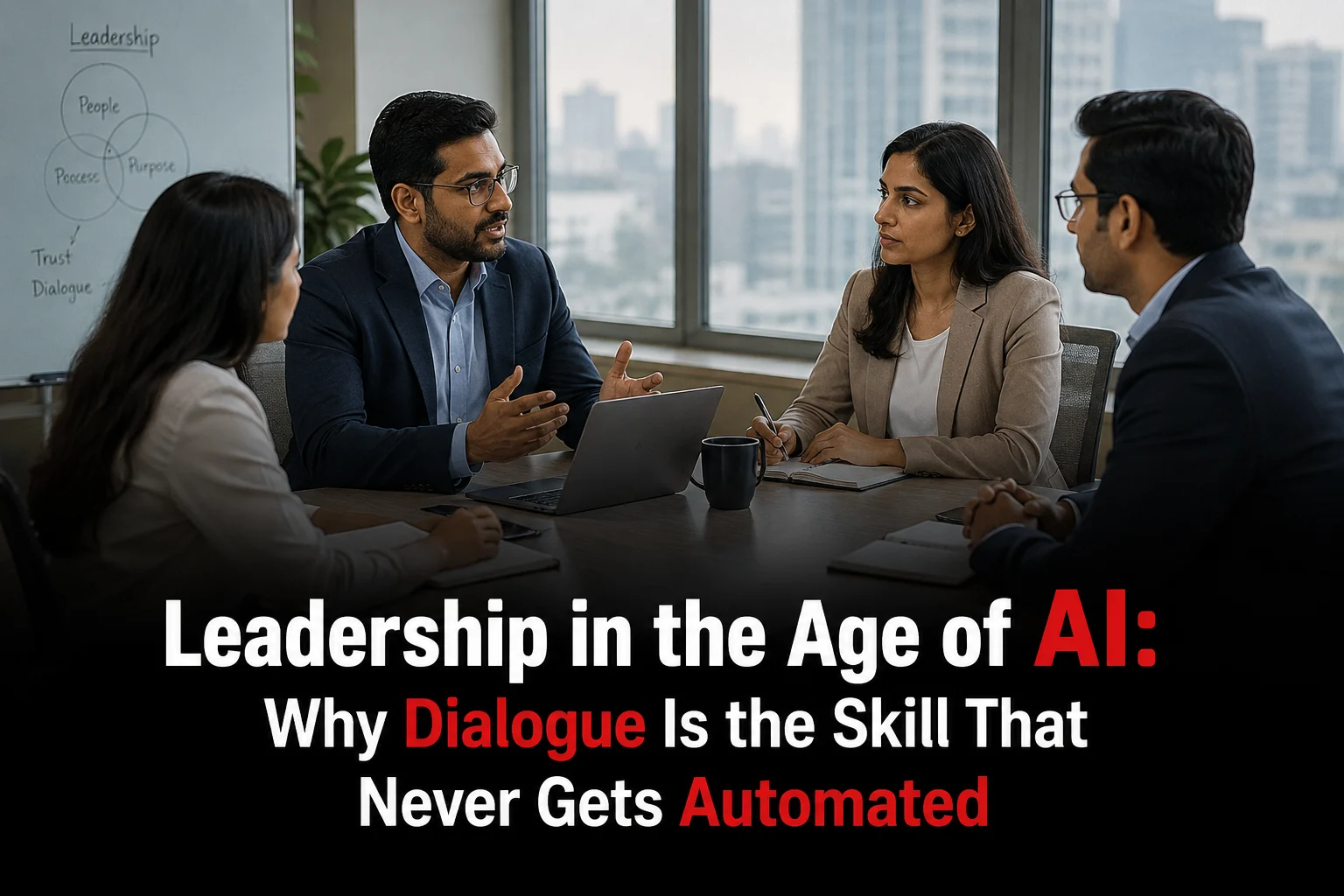
And here is the irony: the more sophisticated our tools, the more human our leadership must be. Leadership in the era of AI is not a battle of wits and skill with machines, which will always triumph in such battles because they process data better than we ever could. Rather, leadership in the age of AI is about doing all those things that a machine cannot do: assessing a room, picking up on unseen tensions, resolving a dispute between two parties whose interests are at odds, and inspiring others amidst doubt.
That gap isn’t a technology gap; it’s a leadership development gap. Organizations are pouring money into tools while under-investing in the communication skills for leaders that determine whether those tools actually get adopted, trusted, and used well by the humans in the room.
The AI savviness gap
A recent Gartner survey found that 77% of CEOs believe AI is ushering in a new business era, yet they feel their organization's leading technology experts lack the knowledge and capabilities to support, drive, or accelerate business outcomes in this evolving landscape.
Why Soft Skills in the Age of AI Are Becoming the Real Differentiator
For far too long, “soft skills” were used as a euphemism for all the things that were difficult to measure and easy to put off until later. Times have changed. In the world of artificial intelligence, soft skills are not an optional bonus for a performance review but the key driver that distinguishes leaders who excel from those who merely cope. With automated reporting and analysis, those skills that only humans can do – listening, empathy, persuasion, facilitating a difficult conversation – become the defining skills of leadership. Soft skills in the age of AI are no longer a nice-to-have footnote; they are the baseline expectation for anyone leading people.
Think about how things play out for a manager who needs to give bad news, mediate a dispute between two coworkers, or bring together a team across functions around an unpopular decision. No dashboard is going to do that. Soft skills in the age of AI become practical because they’re reflected in employee turnover rates, employee engagement, and whether the people working on a team have enough confidence in management that bad news gets surfaced before it becomes a crisis.
A UK-based survey covered by Raconteur found that purpose and social awareness, along with vision and ambition, were flagged by respondents as critical leadership traits that machines would struggle to reproduce (Raconteur, 2025). Or put another way, precisely those qualities that have been developed through leadership training for their ability to foster empathy, judgment, and authentic dialogue are those that will be needed in order to preserve them in an age of increased automation. That is the crux of soft skills in the age of AI. They do not represent a turn away from technology, but toward it.
Dialogue: The One Skill AI Still Can't Replicate
Every conversation that takes place between a leader and another individual- whether it be a private discussion, a performance appraisal, an aggressive negotiation, or an important conversation about responsibility- contains a level of importance that cannot be comprehended by a chatbot. The use of AI technology could allow a machine to compose an email, summarize a discussion, or provide topics for discussion. However, it cannot understand the flicker of uncertainty in a person’s eye, modify its communication approach halfway through based on rising defensiveness, or know when silence would speak louder than an objection.
And here’s where AI and the art of leading meet in a crucial but underappreciated sense. They do not compete against each other; rather, they complement each other. Artificial intelligence can open the schedule of a leader to give her more time for meaningful conversation, and it can bring out facts that will make a challenging conversation a well-informed one. But it cannot engage in conversation itself. Those leaders who grasp this difference look at them as two different forms of investment which strengthen each other.
“Crucial Conversations®“- As AI reshapes how organizations work, the real barrier isn’t the technology; it’s whether people can talk about it openly, disagree about responsible use, and speak up when something feels off, instead of staying quiet.
That’s where leadership shows its edge. In an office running on AI-generated summaries, the leaders who can still walk into a room, meet someone’s gaze, and work through a hard disagreement face-to-face are the ones who stand out. The organizations that win with AI won’t just have the smartest tools; they’ll have cultures where people feel safe enough to speak up and adapt together.
What Leadership Development Must Look Like Now
With dialogue being the essence of leadership in the age of artificial intelligence, leadership training and development should change to keep pace with this change. It is not sufficient to train leaders on how to interpret dashboards and KPI reports, although this remains important. The new developmental journey for a leader should intentionally develop their skills in navigating tough dialogues, how to disagree without being disrespectful, how to hold someone accountable without harming the relationship, and how to remain calm and curious during the discussion. In practice, this means leadership development budgets need to shift as much toward practicing real conversations as they do toward technical AI literacy.
This is precisely the gap that structured behavioral skills training is designed to close. Learning frameworks built around The Four Crucial Conversations for Behavioral Agility give leaders a repeatable, practical way to navigate exactly these moments: the conversations about performance, commitments, safety, and change that most leaders instinctively avoid because they don’t know how to start them. Rather than leaving dialogue to chance or personality, this kind of training gives leaders a structured, teachable method for staying in the conversation instead of walking away from it.
It becomes even more significant in an AI-entrenched working environment, and one of the best examples of how leadership in the age of AI cannot be wholly automated is that leadership itself is founded on the capacity to engage in high-stakes communication. It’s also proof that soft skills in the age of AI are not a soft option at all; they are the hard skill that keeps everything else credible.
Building Communication Skills for Leaders in a Hybrid, AI-Enabled Workplace
The communication skills of leaders are different from what they were a decade ago. In this new age, leaders have to manage hybrid teams in different time zones, collaborate with their AI copilots, and make decisions that are largely influenced by the algorithms that need to be translated into human language. The communication skills of leaders require that they be able to communicate their AI-driven decisions fairly and openly.
Leaders with strong communication skills also know when it is necessary to avoid using any kind of technology. When employees need to be informed regarding any kind of restructuring or non-promotion, there is simply no way in which any kind of AI-generated text could replace leaders’ own voice and tone. In the current day and age, leaders need to have good communication skills, which include knowing when certain types of conversations need to be had face-to-face.
This is also the point at which leadership development and communication training come together. Communication programs aimed at developing the skills of leaders through active listening, constructive feedback, and clear messaging are no longer just additional training but are, rather, integral to developing competent leaders along with strategic thinking and business acumen.
Ready to Make Dialogue Your Leaders' Sharpest Skill?
Give your leaders a repeatable way to navigate the conversations AI can't have for them — performance, accountability, and change — with The Four Crucial Conversations® for Behavioral Agility. Build the human skills that keep every AI-driven decision credible.
Build Your Leadership BenchWhy AI and Leadership Skills Must Be Developed Together
Getting this balance right is one of the defining challenges of leadership in the age of AI.
It is a wrong approach to think about this as an either-or option between the two. The companies that get this right are those that invest in both at the same time: providing their leaders with AI tools to free them from any administrative burden, and at the same time, ensuring they are equipped with all the human skills that cannot be taught by these AI tools.
Effective leaders who leverage AI and leadership skills utilize the power of data in preparing to enter the discussion, but ultimately, they enter the discussion. They employ AI in drafting the discussion and use their personal judgment in making the decision. They rely on automation to save time and redeploy the saved time in coaching, mentoring, and communicating with their employees, which is what a leader does in the age of AI.
Read More: How to Improve Workplace Productivity: 12 Strategies That Actually Work
Preparing Leaders for What's Next
The future of AI and leadership will certainly continue to develop further, but the rate of change will only increase and not decelerate. However, the principles of effective leadership will certainly become more and more clear rather than unclear. Effective leaders in the era of AI will be those who are able to merge their knowledge of technology with human relations and to talk face-to-face about something difficult while using a particular tool.
AI-based soft skills, communication skills of leaders, and structured programs for developing people are no longer independent initiatives on an HR calendar. They have merged into one key issue: creating leaders who are able to conduct important conversations with confidence and success, even when all the processes around such conversations are automated. It is these organizations that understand this point that will create leaders who will stay relevant, competent, and effective under any scenario of leadership in the age of AI.
FAQs
Leadership in the age of AI means leading teams where routine analysis, reporting, and even first-draft communication are increasingly automated. It shifts a leader's core job toward the things AI cannot do: building trust, navigating conflict, and having honest, high-stakes conversations. Leadership in the age of AI is less about mastering new software and more about strengthening timeless human skills.
AI can process data and surface options, but it cannot build trust, mentor a struggling employee, or navigate a sensitive conversation about performance. Leadership development focuses on precisely these human capabilities, which is why it remains one of the highest-return investments an organization can make, even as automation expands.
The core principles remain the same, but the context has changed. Communication skills for leaders now also include explaining AI-influenced decisions clearly, managing hybrid and distributed teams, and knowing when a conversation absolutely requires a human voice instead of an automated update.
As automation removes routine tasks, employees increasingly judge their workplace by how they are treated, heard, and led. Soft skills in the age of AI- empathy, active listening, fair feedback- directly influence whether employees trust their leaders and stay engaged, making them a measurable driver of retention.
They complement rather than compete. AI and leadership skills work best as a paired investment: AI reduces administrative load and surfaces better information, freeing up time that can be reinvested in coaching, dialogue, and relationship-building, the areas where leadership development delivers its greatest impact.
Start with structured, practical frameworks rather than generic workshops. Programs built around real-world crucial conversations, like The Four Crucial Conversations for Behavioral Agility, give leaders a repeatable method for handling accountability, performance, and change conversations well, making leadership development concrete and actionable rather than theoretical.