Most workplace challenges are not caused by a lack of technical skills; they are caused by strained relationships, unclear motivations, and unmanaged conflict. Leaders and teams struggle not because they lack knowledge, but because they misunderstand what drives behaviour. Leaders and teams have a hard time when there is a lot of stress, disagreement, and confusion about what people want. This is where the Strength Deployment Inventory SDI® stands apart from traditional personality assessments. SDI doesn’t put people together based on what they like or how they act. Instead, it looks at why people act the way they do, especially when they’re mad or disagree with something. The development of SDI 2.0 reflects a major evolution in how organizations understand motivation, stress behavior, and relationship dynamics.
The Strength Deployment Inventory is based on the idea that being aware of your relationships can help you understand how your values affect your behaviour. The SDI is different from other tests that can tell you how someone thinks or acts. It can also tell you what really drives them and how those drives change when they’re stressed. Trust, communication, and working together all have a direct effect on performance in today’s fast-paced, high-stakes workplaces.
But as businesses went global, digital, and more complicated, the first SDI had to change. Things at work these days are what led to the creation of SDI 2.0. People fight more, work from home, and things are always changing. SDI 2.0 turns behaviour insights into useful information that you can use right away. This helps leaders and teams build cultures based on understanding, clarity, and results, as well as deal with conflict and improve relationships.
Understanding the Original SDI Framework
The original (SDI®) was made to answer a question that most personality tests don’t: Why do people act the way they do, especially when they’re with other people? The Strength Deployment Inventory was created to learn what drives people to act, not just how they look or what kind of personality they have. Because of this focus, SDI was especially useful in workplaces where people often fight because they don’t understand what others want.
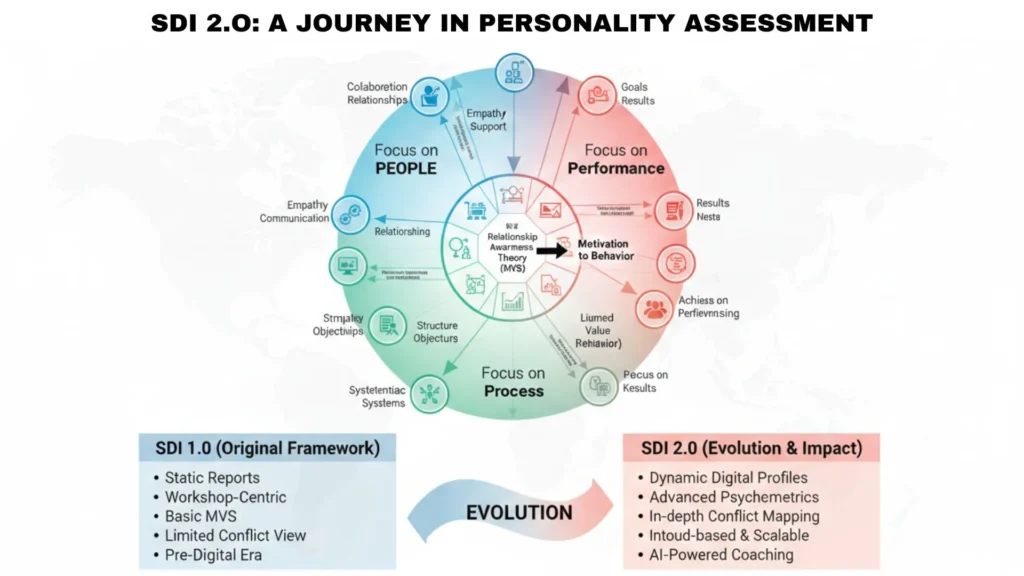
Relationship Awareness Theory is the main idea behind the growth of SDI®. This theory says that behaviour is something you can see, but motivation is what makes it happen. People communicate better, settle differences more quickly, and build stronger working relationships when they know what each other’s motivations are. SDI® made this idea work by turning motivation into clear, observable patterns.
To do this, SDI came up with Motivational Value Systems (MVS), which show what people value most when things are going well. Rather than placing individuals into rigid personality types, SDI identifies motivational priorities — what matters most to a person when relationships are going well.
- People (Blue): Worked together, helped others, and kept the peace.
- Performance (Red): Focused on getting things done, being efficient, and reaching goals
- Process (Green): Motivated by analysis, structure, objectivity, and systematic thinking.
This framework became the foundation for decades of leadership and team development work across industries. At the time, what made SDI® stand out was that it could link motivation directly to behaviour. Other tests showed how different people are, but SDI® showed why those differences are important in real life. This is an important tool for building teams and leaders.
Limitations of Early SDI and the Need for Evolution
The original SDI® shed light on human motivation and behaviour, but its flaws became more apparent as businesses evolved. At first, holding workshops and classroom instruction was SDI’s first priority. Organisations struggled to regularly employ SDI in fast-paced, everyday work environments due to this predefined format. When it was useful, it did its job.
A new challenge emerged when companies expanded globally: how to expand even more. The original SDI was created when most teams were located in the same physical location. Companies operating on a global scale require a means of bridging cultural and geographical divides within their teams so that they can collaborate and maintain consistency. These requirements were not well addressed by the previous methods of SDI delivery.
Another limitation was interpretation. Without a trained facilitator, many leaders found it difficult to translate assessment insights into sustainable behavioural change. Workshops created awareness, but without ongoing reinforcement, the impact often faded.
Because of these things, evolution became quite evident. As workplace stress intensified and decision cycles accelerated, organizations needed real-time behavioural insights not static reports. Because of these problems, SDI 2.0 was made. It changed the SDI® from a single test to a flexible and extendable system that works well in modern workplaces.
Build Motivation Driven Leadership with SDI 2.0
Discover how SDI 2.0 transforms behavioural insight into real time action, helping leaders strengthen relationships, navigate conflict, and drive measurable performance.
The Development of SDI 2.0
The SDI 2.0 wasn’t just a fresh appearance; it was a completely new way of thinking about how to assess and use motivation, behaviour, and relationships in real time. The Strength Deployment Inventory was put through a lot of research and testing to make sure it would still be useful in workplaces that are getting more complicated, since organisations needed more thorough information and accurate results.
SDI 2.0 is based on advanced psychometric science. Extensive psychometric validation studies and behavioural data analysis were conducted to enhance reliability and measurement precision. This study made the assessment more reliable while keeping the original goal of SDI, which was to figure out why people do what they do. SDI 2.0 measures motivation as a force that changes when there is stress, conflict, or pressure. This is different from many personality tests that look at attributes that don’t change.
While the SDI 2.0 was being produced, the idea of motivation was updated to better match the needs of today’s workplaces. Cross-functional teams that work together from far away and make key judgments need more accurate behavioural mapping. SDI 2.0 helps you understand the different reasons for doing things and how those reasons vary over time.
Another important change was going from reports that were primarily based on theory to reports that were based on facts. The SDI became a system that uses data to mix behavioural science with performance statistics. This transition helps leaders, coaches, and organisations progress from just knowing about the problem to actively changing how they operate over time.
The SDI 2.0 was made with a lot of study, new technology, and years of experience. It made SDI into a scientifically valid framework that a lot of people can use. In the actual world, it assists with leadership effectiveness, team alignment, and the culture of the organisation.
Core Enhancements Introduced in SDI 2.0
One of the best things about producing SDI 2.0 was that it got a lot of good new features. The first SDI taught us a lot about how people think and act. SDI 2.0 converts that data into valuable, accurate information that teams and leaders can use every day.
The Strengths Portrait is much better now. People can see all 28 strengths in SDI 2.0, not just a few. This will give you a fairly accurate “thumbprint” of how someone generally communicates, acts, and works. The users learn more about how their skills function in real life, not simply in general groups.
Another major step forward is the examination of too many strengths. SDI 2.0 knows that if you use your strengths too often, especially when you’re pressured, they might become weaknesses. The Strength Deployment Inventory shows people how good intentions might make other people tense or resistant by showing them these patterns.
SDI 2.0 also made it easier to map Conflict Sequences in a more complex fashion. This progress indicates that when people are under a lot of stress, their major goals for getting things done change. Users can estimate how other people would act in a quarrel and modify their own behaviour before things become worse. These recommendations will be incredibly beneficial for leaders who need to talk about tough things.
Digital Transformation
The SDI 2.0 changed from being a stand-alone test to a fully digital ecosystem. This was a huge stride forward in its history. This adjustment was made because behavioural insight is most beneficial when it can be applied straight away, not weeks after a workshop or coaching session.
SDI 2.0 is a cloud-based platform that works best on mobile devices. It lets people and teams examine their Strength Deployment Inventory findings from any device at any time. Instead of getting reports that stay the same, users get profiles that alter as they use and think about them. This means that SDI® is a living system and not just a one-time-use diagnostic tool.
Real-time coaching support is one of the coolest new features. SDI 2.0 delivers good suggestions before meetings, during hard talks, and when there is a fight. Leaders don’t have to memorise or read instructions to leverage behavioural insights with SDI 2.0. Leaders now do these every day.
When SDI can be utilised with platforms like Microsoft Teams and Slack, it becomes even more a part of everyday life in an organisation. With these integrations, users can estimate how their coworkers would read communications, handle stress, or set priorities for results. This helps people not get things wrong in the first place.
With SDI 2.0, you can always know what’s going on and take action right away. The Strength Deployment Inventory is now available online. This will aid with consistent behaviour modification, scalable learning, and long-lasting relationship effectiveness in modern, scattered organisations.
Difference between SDI and SDI 2.0
The initial edition of SDI taught us a lot about what drives individuals, but the second version, SDI 2.0, made that information far more helpful in the actual world of business. The most essential transition is going from knowing to doing. The early SDI was largely about figuring out “why” people do things. SDI 2.0, on the other hand, links those “whys” to actions and results that are easy to perceive.
SDI used to rely on static reports and workshops led by professionals. This strategy worked, although it wasn’t always easy to utilise. Instead of static reporting, SDI 2.0 employs digital profiles that adapt based on roles, stress levels, and social needs. This makes the Strength Deployment Inventory a lot more useful in places where things happen fast.
Another big distinction is how well people comprehend conflict. SDI thought up the idea of conflict sequences. SDI 2.0 adds a detailed map that shows how employing strengths too much can cause stress and confusion. This provides leaders and teams a better chance to jump in sooner.
It also got easier to understand. SDI 2.0 delivers personalised, automated coaching insights that make it less important for an expert to manage the session. It will be easier for more organisations to employ SDI principles now that managers can comprehend and use them without a lot of training.
The most essential factor is that scalability changed a lot. SDI 2.0 gives digital access and connections to global, remote, and hybrid teams so they may work together. The Strength Deployment Inventory has been altered from the original SDI into a method for training leaders and building relationships that can grow and evolve over time.
Real-World Applications of SDI 2.0
When used in everyday work situations, SDI 2.0 shows its true worth. The Strength Deployment Inventory is used by businesses in all fields to put theory into practice and improve leadership, communication, and performance.
SDI 2.0 helps leaders make sure that what they do is in line with what they really want. Leaders make better choices and earn their teams’ trust when they know how their strengths show up and how they might be overused when they’re under a lot of stress. This clarity is very important when talking about and working on changes that have a lot at stake.
SDI 2.0 helps managers see patterns in how their teams are motivated, which makes it easier for them to work together. Now that we know this, we can divide up the work in a way that naturally involves everyone. This makes it easier for people to work together and reduces stress. It’s easier to give feedback and settle differences when teams speak the same language.
A lot of people also use SDI 2.0 to coach their bosses. Coaches rely on the SDI 2.0 framework to give them feedback that is based on facts. This helps clients see what they can’t see and change their behaviour before it hurts their relationships or reputation.
Salespeople and other people who work with clients use SDI to find out what makes customers and other stakeholders tick. This lets them change how they talk to fit the needs of people, performance, or process.
SDI 2.0 makes it easier for teams to talk to each other by showing how messages can be sent and received by both remote and hybrid teams in real time. SDI 2.0 is an important tool for long-term success and good relationships at work because it has these useful features.
History of SDI 2.0 and Global Adoption
The history of SDI 2.0 shows how important it is to enter a world that is getting more linked and stressed. As businesses grew in different parts of the world and countries, leaders needed a way to talk about why people do the things they do. This need led to the creation of SDI 2.0. One thing that makes this structure great is that it can be used anywhere in the world.
Multinational businesses, companies that help people become leaders, and non-governmental organisations around the world were some of the first to use SDI 2.0. This showed that it could work for more places and people. The Strength Deployment Inventory (SDI 2.0) looks at what drives people around the world, while many personality tests use culturally specific standards. In other words, it works everywhere.
The SDI spread all over the world, and the fact that it was digital made it easy for more people to use. Lots of people work for one company, so they might use SDI 2.0 to make sure that everyone used it and understood it the same way. SDI 2.0 was often used to make leaders, manage talent, and settle disagreements because it could be used on a big scale.
The HR professionals use SDI 2.0 to make companies better, and the coaches use it to give clear, data-based advice. As time has gone on, SDI 2.0 has grown from a useful tool for measuring things to a worldwide plan for REI. The new SDI 2.0 changes how companies teach their leaders and get people to work together better all over the world by letting them use lessons about motivation in their daily work.
The Ongoing Development of SDI 2.0
The SDI 2.0 got better and better after it was out. New research, vast collections of behavioural data, and feedback from people who use SDI 2.0 in their organisations make it better all the time. The folks who make SDI 2.0 are continually attempting to make it better, so it stays helpful even when work changes.
The SDI framework is upgraded to accommodate new approaches to work together, lead, and disagree as workplaces become more complex. Working from home, having hybrid teams, and talking to people from other cultures are all putting greater stress on relationships than ever before. This is fixed in SDI 2.0, which makes it easier to notice and understand changes in motivation. SDI 2.0 doesn’t think of motivation as a constant phenomenon. It sees it as something that changes based on the situation.
New technologies are also highly vital for the advancement of SDI 2.0. People and teams can utilise SDI principles when they need them because of greater digital reporting, real-time behavioural insights, and predictive advice. These modifications help individuals understand each other better, modify the way they talk to each other, and stop fights before they grow worse.
SDI 2.0 is still ready for the future because it uses behavioural science and is always coming up with new ideas. As organisations develop, the Strength Deployment Inventory keeps growing better. This helps leaders stay strong, build better relationships, and keep getting better at what they do.
Conclusion
The development of SDI 2.0 represents a significant shift in how organisations view people, their motivation, and their performance. The Strength Deployment Inventory informs you what truly makes people do what they do, which is useful in both regular and stressful situations.
SDI 2.0 used to be a test that didn’t alter, but now it’s a system that is constantly on and useful. It makes leaders better, teams work better, and cultures fit together. It is based on Relationship Awareness Theory and Motivational Value Systems, which makes it easier for people to understand. Not only their strengths, but also how those strengths alter when things go rough, when there is a struggle, or when the stakes are high.
It’s not enough to just know how to use technology in today’s dynamic settings. Leaders and teams need to be able to deal with relationships in a clear, caring, and purposeful way. Everyone can understand SDI 2.0, which makes it easier for teams to work together and for people at all levels to trust each other.
People at Crucial Learning India utilise SDI 2.0 to alter their behaviour, not merely to learn. SDI 2.0 is a proven technique to make leaders, teams, or a healthy culture.
Invest in SDI 2.0 to build relationships that drive results.