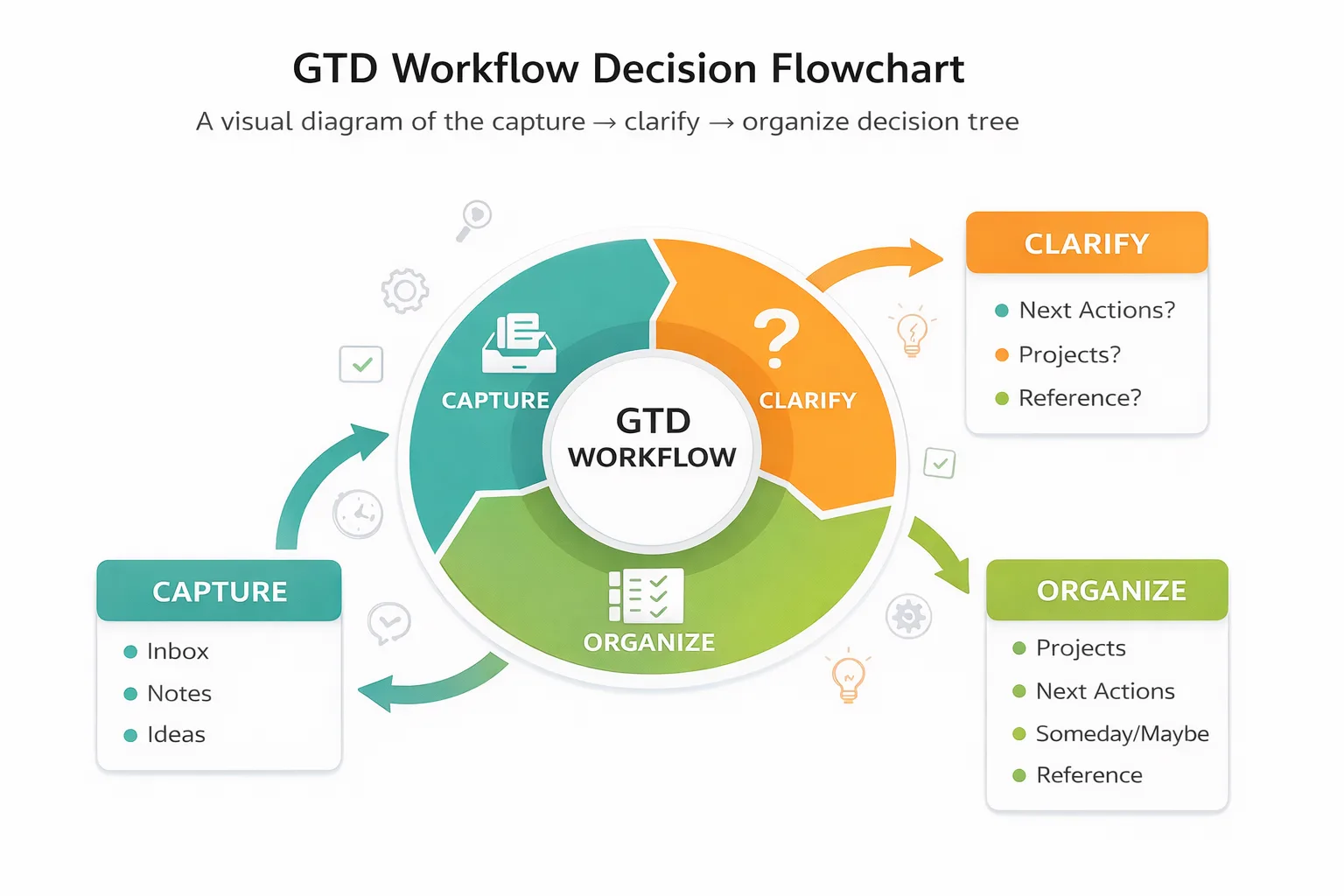
What is the GTD Method?
The Getting Things Done® (GTD) method is an approach to assist people and groups get things done, lower their stress levels, and stay focused in a world that is getting more complicated. The idea behind “Getting Things Done®,” or GTD, is simple but works. When you continuously think about things you have to do, you lose focus. Using the GTD method can help you organize, keep track of, and follow through on your promises with confidence. Leaders use GTD to make sure that tasks are done correctly, that teams are on the same page, and that strategies are clear.
Getting Things Done® is more than just a list of things to accomplish at its most basic level. Most productivity tools are made to help you figure out what chores are most important. GTD, on the other hand, figures out what the next concrete step is to move a project forward after making sure that the expected impacts are clear. With this change, productivity goes from doing tasks to moving forward on purpose. The GTD method’s full process lets people keep track of meetings, emails, projects, and long-term goals all in one place.
The Getting Things Done® method is based on research in psychology on cognitive load. You can think more strategically and creatively when you store your commitments in a reliable external system rather than in your memory. As a result, GTD is a comprehensive strategy for completing tasks rather than merely a list of tasks. It facilitates decision-making, planning, and adherence.
GTD makes people and professionals more productive, whether they’re using it for daily tasks, coordinating a team, or being a leader. The GTD method gives people a reliable way to keep track of their responsibilities, which helps them stay focused on what counts. GTD gives teams and managers a structured way to increase accountability, alignment, and consistency in how things get done.
How the GTD Method Works
The GTD method is based on a strong idea that David Allen calls “mind like water.” The idea is simple: when your mind is clear, it reacts in the right way to whatever happens. It stays calm when things are calm and focused when action is needed. GTD helps you get to this state by getting rid of mental clutter and replacing it with a reliable outside system.
The GTD method works by getting you to put all of your commitments tasks, ideas, deadlines, and responsibilities somewhere safe outside of your head. You don’t have to remember everything; you just capture it. Getting Things Done® is based on the idea that untracked commitments lead to cognitive overload. When your brain keeps reminding you of things you need to do, it makes it harder to focus and more stressful.
GTD cuts down on that overload by putting commitments into a structured system. The GTD method then makes you make each item clearer by figuring out what the next action is that needs to be taken. GTD asks you to do things like “Prepare presentation” instead of keeping vague notes. What is the next step? Making a reservation for a meeting room? Getting data? This focus on next steps stops people from putting things off and clears up any confusion.
The GTD method works for another reason: it separates being busy from being productive. A lot of professionals are busy all day but don’t get much done that matters. GTD focuses on clear goals and actions that can be taken, making sure that strength is directed where it will have the most impact.
The GTD method helps people make decisions less often. You don’t have to spend as much time figuring out what to do next when your tasks are already clear and organised. GTD lets you act on purpose instead of on impulse. This structured method leads to calm, control, and steady progress over time, which is exactly what the Getting Things Done® framework was meant to do.
The 5 Core Steps of the GTD Method
The GTD method works well because it has a clear, repeatable process. GTD gives you five basic steps that help you stay organised, clear, and in control instead of relying on memory or motivation. These steps are the most important part of the Getting Things Done® method and make sure that nothing is missed.
1. Capture
The first thing you need to do with the GTD method is write down everything that is on your mind. This includes things like tasks, ideas, emails, promises, reminders, and even vague worries. Getting things done (GTD) starts with capturing, because not collecting inputs can lead to forgetting important tasks.
The GTD method says to put all of your inputs into trusted systems, like digital apps, notebooks, or task managers. The most important thing is to be consistent. Your brain stops trying to remember things when it thinks it has everything. GTD clears mental clutter and restores focus. This is where GTD starts reducing mental clutter and restoring focus.
2. Clarify
The next step in the GTD method is to clarify after items have been captured. You decide here if something can be done. If it isn’t, you can either delete it, save it for later, or store it as reference material.
GTD asks one important question: “What’s the next action?” The GTD method is based on this logic. GTD doesn’t just manage vague tasks; it turns them into clear, physical actions. This stops people from putting things off and getting confused, which makes progress much more likely.
3. Organise
You need to arrange your obligations into the correct categories after you grasp the GTD process. GTD employs structured lists like “Next Actions,” “Waiting For,” “Projects,” and “Someday/Maybe,” as well as calendar entries for things that need to be done at a given time.
The organising phase makes sure that the GTD technique puts commitments in the right sequence. GTD makes things clearer by grouping them instead of putting them all on one long list. This organised way of doing things is a big aspect of the Getting Things Done® process and what makes it effective for more difficult jobs.
4. Reflect
The GTD technique works and remains viable because people get results from it. During a Weekly Review, you look over your projects, update your lists, and make sure your system is up to date. GTD knows that if you don’t think about your systems, they get old soon.
The Weekly Review creates trust in the GTD method by making sure that promises are still clear and can be followed through on. This habit keeps things clear and stops items from piling up.
5. Engage
The last step in the GTD method is to engage, which means deciding what to work on based on the context, the time you have, your energy level, and your priorities. Because GTD has already made tasks clearer and more organised, making decisions is easier.
GTD lets you carry out tasks with confidence once you have a complete system in place. The GTD method lets you act with clarity and control instead of second-guessing. This is where the structure of GTD turns into steady, meaningful progress.
GTD Method Workflow Explained
The GTD method works as a never-ending workflow loop that makes sure commitments are clear and can be acted on. GTD doesn’t let you work on tasks one at a time; instead, it has a cycle that you can repeat: Inbox → Process → Organise → Review → Execute. This loop makes sure that nothing gets stuck, forgotten, or left undefined.
An inbox is where everything starts. Your inbox is where you keep all of your emails, meeting notes, ideas, messages, and tasks in the GTD method. GTD doesn’t want you to work directly from your inbox; instead, it wants you to check it often. Processing means figuring out what each thing means and whether anything needs to be done.
Next is putting things in order. Once you know what your commitments are, the GTD method organises them into structured lists, like Next Actions, Projects, or calendar entries. This is where the system starts to really take charge. GTD separates thinking from doing, so you can make decisions ahead of time.
Reviewing is what keeps the GTD method workflow steady. You keep your system up to date and reliable by doing regular reviews, especially the Weekly Review. Even the best system falls apart if it isn’t reviewed. GTD stays clear by keeping lists up to date and in line with what is most important.
The GTD method has already captured, clarified, and organised your commitments, so you can now fully focus on getting things done. Getting Things Done® is so helpful for busy professionals with a lot to do because it has a structured method.
It’s important to remember that GTD is both structured and flexible. You can use it with notebooks, planners, digital apps, or a mix of the two. You might use different tools, but the way you use the GTD method stays the same. One person or a complicated work environment can use GTD because it has a clear structure and tools that can be customised.
Examples of the GTD Method in Real Life
It’s good to know the theory behind something, but seeing the GTD method in action makes it really useful. GTD works in many different types of jobs and makes things go more smoothly in the real world. Here’s how this works in practice for various roles…
Senior Leader Managing Strategic Priorities
A senior leader often has to deal with board meetings, long-term strategy, conversations with stakeholders, and making decisions within the company. Things get mixed up when there isn’t any structure. The leader uses the GTD method to turn strategic initiatives into projects, make clear next steps, and plan important milestones. By doing regular reviews, GTD makes sure that daily tasks are in line with the long-term vision. Instead, they use the GTD method to focus on what really matters to the organisation. Getting Things Done® helps clarify the strategy here.
Project Manager in Charge of Tasks Across Departments
There are many people, deadlines, and things that need to be done that project managers have to deal with. With GTD, they can keep track of each deliverable as a separate project. Structured lists, such as “Waiting For,” make sure that follow-ups don’t get lost. The GTD method separates information that can be used as a guide from tasks that need to be done. This makes things less stressful. This helps groups keep moving forward. Taking actionable steps based on reference data makes progress observable across teams.
Sales Professional Managing Follow-Ups
Follow-up and relationship management are very important for salespeople who want to be successful. GTD helps you keep track of every lead interaction, proposal due date, and the GTD method makes sure that follow-ups are put in the right lists or on your calendar so that you don’t have to rely on your memory. This methodical approach makes things more consistent and builds trust, which are two very important factors that affect performance. Getting Things Done® transforms scattered outreach into structured engagement.
Entrepreneur Balancing Business and Life
Business owners often have a hard time separating their work and personal lives. By using GTD, they make a single system that keeps track of both work projects and personal tasks. By making priorities clearer and getting rid of mental clutter, the GTD method helps people get more done. Entrepreneurs use GTD to get back in charge and focus on growth instead of always feeling behind.
HR Leader Coordinating Training Programs
An HR manager in charge of several training programs can use the GTD method to keep track of sessions, vendor coordination, participant communication, and evaluation processes. GTD makes sure that nothing is missed by breaking tasks down into steps that can be taken. The structured flow of this productivity system makes it easier to carry out tasks and measure progress, even when they are complicated.
GTD Method Checklist
If you want to implement the GTD framework effectively, consistency is key. Here is a useful list of things to do to help you use GTD in your daily work and develop discipline over time. The following checklist translates the methodology into daily action.
- Capture all inputs daily. The GTD method says that nothing should stay in your head. Write down or record every task, idea, promise, and reminder. GTD is based on consistently capturing things.
- Process your inbox to zero. Don’t use your inbox as a place to store things. With the GTD method, you have to regularly go through each item and decide what it means and what you need to do about it. Processing to zero keeps your system clean and dependable.
- Define a clear next action. For each actionable item, find out exactly what the next physical step is. This productivity system gets rid of tasks that aren’t clear and replaces them with actions that are. This clarity is what makes GTD work.
- Maintain organised lists. Keep organised groups like Next Actions, Projects, Waiting For, and Someday/Maybe. The GTD framework relies on organised lists that accurately depict reality. Even GTD doesn’t work as well without structure.
- Conduct a weekly review. The Getting Things Done® method requires that you do the Weekly Review. Go over projects, make new lists, and tie up loose ends. This step keeps your GTD method going while keeping the system up to date and reliable.
- Execute with clarity. When it’s time to work, believe in your system. Because GTD has already made commitments clear and organised, doing them makes you focused and sure.
The GTD method is simple but it requires discipline. When practised consistently, GTD transforms scattered effort into structured progress.
Turn Overwhelm Into Clear Action
The Getting Things Done methodology helps professionals capture tasks, clarify priorities, organize commitments, and focus on what truly matters. Build a system that helps your team stay productive, reduce stress, and get meaningful work done consistently.
Benefits of the GTD Method
The GTD framework’s real strength is not simply how it helps you stay organised, but also how it changes how you feel and how well you do your work. GTD alters the way individuals think, make choices, and do things when they use it all the time.
One of the best things about the GTD is that it reduces cognitive load and improves executive focus. You don’t have to recall everything when you write down and make explicit your promises. This mental clarity helps professionals move from putting out fires to taking deliberate action. Instead of being overwhelmed, GTD provides you with control.
Another one of the key advantages is that you can focus better. Distractions lose their power when you employ this productivity system, which requires you to clearly outline your next steps. GTD helps you stay on track and make genuine progress instead of jumping from one activity to another. Getting Things Done® goes beyond just giving you suggestions on how to be more productive; it also helps you focus better.
The GTD method also makes people more responsible. It’s easy to identify who is in charge of what when projects and next actions are clear. GTD makes it easier to keep track of what you need to do, follow up, and finish things, whether you’re working alone or with others.
Naturally, this leads to better decisions. The GTD framework cuts down on decision fatigue by putting tasks into organised groups and doing regular evaluations. Professionals spend less time thinking about what to do next and more time doing it with confidence. Getting Things Done® makes it easier to think clearly while you’re under pressure.
GTD helps teams get more done on a bigger scale. It’s easier for teams and leaders to work together, and there are fewer mistakes when they all adopt the same workflow. The GTD technique ensures that everyone in the firm knows what needs to be done to achieve the company’s strategic goals. There are fewer misunderstandings, and coordination and shared workflow get better. The GTD technique makes it so that everyone in the firm knows what has to be done to attain strategic goals.
GTD makes you more productive over time. The GTD approach is a reliable strategy to get things done, rather than relying on sudden bursts of motivation. It helps you develop habits of self-reflection, clarity, and consistent execution that change productivity from a problem into an advantage that you plan to use.
Common Mistakes in the GTD Method
This productivity system is easy to understand, but it only works if you use it correctly and consistently. Many professionals have trouble not because GTD is wrong, but because they don’t apply it fully.
One major mistake people make when using the GTD framework is not writing down everything. If you hold chores in your thoughts instead of placing them in a solid method, mental clutter comes back. For GTD to operate, your brain needs to be totally sure that every promise has been written down.
Not doing the Weekly Review is another common mistake. The GTD technique relies heavily on reflection to keep accurate and up to date. If you don’t check on projects and update lists, your system falls out of date pretty soon. People stop believing in GTD when that happens, and so does consistency.
Another way to become stuck is to make tools too hard to use. It’s not about the program; it’s about the way things are done. Some people spend more time changing the settings on their apps than they do working. The Getting Things Done® technique says that tools should assist you in staying focused, not get in the way.
Mixing up projects with future actions also makes things less effective. A project is any intended objective that needs more than one step to get there. The next action is a single, clear job. When GTD lists include imprecise project names instead of clear actions, progress stops.
Lastly, inconsistent implementation damages results. You don’t just set up the GTD system once; you utilise it every day and every week. People who only use GTD occasionally don’t obtain all of its benefits.
When used appropriately, GTD helps you see things clearly and take charge. If you don’t use the GTD approach correctly, it can feel like too much or not work at all. When you are diligent and keep things simple, GTD works best.
The Two-Minute Rule and When to Break It
One of the most well-known and immediately actionable parts of the GTD method is the Two-Minute Rule. The principle is straightforward: if a task will take two minutes or less to complete, do it now. Don’t capture it, don’t schedule it, and don’t add it to a list. Just act on it immediately.
The logic behind this rule is rooted in efficiency. The time it takes to write down a two-minute task, categorise it, revisit it during a review, and then eventually act on it often exceeds the time needed to simply complete it. GTD recognises that small tasks, if deferred, accumulate into a mental and logistical burden. The Two-Minute Rule prevents that pile-up.
In practice, this rule is most powerful during the Clarify step of the GTD method. When you’re processing your inbox and come across a quick reply to send, a short document to file, or a brief update to communicate, handle it immediately. This keeps your system lean and your lists reserved for tasks that genuinely require planning and effort.
When to Break the Two-Minute Rule
Like most productivity principles, the Two-Minute Rule comes with important nuances. There are times when applying it too liberally can actually hurt your focus and output.
- During deep work sessions: If you are in a focused block of strategic work, interrupting it to handle micro-tasks breaks your concentration. In this context, capture those two-minute items for later rather than acting on them immediately. Protecting your focus is more valuable than quick task completion.
- When volume is high: During busy processing sessions with a large inbox, applying the Two-Minute Rule to every small item could consume an hour or more before you even begin organising. In such cases, batch similar small tasks and handle them in a dedicated time block.
- When the task is a distraction disguised as productivity: Responding quickly to a low-priority message or fixing a minor formatting issue may feel productive, but if it takes you away from high-value work, it is actually counterproductive. GTD asks you to be intentional, not just responsive.
The Two-Minute Rule is a tool for clearing small friction, not a licence to react to every incoming request. Used wisely within the GTD framework, it keeps your system clean and your attention focused on what genuinely matters.
GTD Contexts: How to Organise by Energy, Location & Tool
One of the most underutilised yet powerful features of the GTD method is the concept of contexts. A context is a label that describes the condition required to complete a task — the location you need to be in, the tool you need to have, or the energy level the task demands. By organising your Next Actions list by context, GTD allows you to make faster, smarter decisions about what to work on at any given moment.
Rather than staring at a long, undifferentiated list of tasks and trying to decide what to tackle, you simply look at your context-specific list based on where you are or what you have available. This is one of the most practical design features of the Getting Things Done® framework.
Common GTD Contexts
Contexts can be tailored to your specific work environment and lifestyle. Some commonly used examples include:
- @Computer — Tasks that require a laptop or desktop, such as drafting reports, responding to detailed emails, or updating project trackers.
- @Phone — Calls or voice messages that can be batched and completed during a commute or between meetings.
- @Meetings — Items to discuss or decisions to make the next time you are with a specific colleague or team.
- @Errands — Tasks that require physical presence in a location, such as a bank, post office, or store.
- @Deep Work — Tasks that require sustained focus and should be reserved for protected time blocks with minimal interruptions.
- @Low Energy — Simple, low-stakes tasks such as filing, organising, or reading newsletters, ideal for the end of a working day when concentration is lower.
Organising by Energy
Context-based GTD organisation is particularly effective when you align tasks with your natural energy rhythms. High-cognitive tasks like strategic planning, complex problem-solving, or writing should be slotted into your peak-energy windows. Routine or administrative tasks fit better in low-energy periods. The GTD method does not prescribe when you work; it ensures that when you are ready to work, you always have a clear and appropriate list to draw from.
Organising by Tool
In modern work environments, the tools available to you often determine what is possible at any moment. GTD’s context system accommodates this by allowing you to tag tasks by the tool they require whether that is a specific software platform, a whiteboard, a printer, or even internet access. This is particularly useful for remote workers, field professionals, or those who move between multiple work environments throughout the day.
When contexts are set up thoughtfully and maintained consistently, they transform your GTD system from a storage tool into a real-time decision engine one that matches your capacity and environment at any given moment to the most appropriate work available.
GTD in the Indian Workplace
The Getting Things Done® method was developed and popularised primarily in Western corporate contexts. However, its principles are not culturally bound and in fact, they address some of the most pressing productivity challenges specific to the Indian workplace. Understanding how to adapt and apply GTD within the realities of Indian professional environments makes the framework even more powerful and relevant.
Challenge 1: High-Interruption Office Cultures
In many Indian organisations, open-door policies, hierarchical accessibility expectations, and a culture of in-person consultation mean that interruptions are frequent and socially expected. Professionals are often pulled out of focused work by colleagues, managers, or direct reports throughout the day.
GTD helps here by creating a structured capture-and-defer habit. Rather than attempting to hold every incoming request in your head or respond to everything immediately, the GTD method trains you to quickly capture incoming items a note, a task, an idea and return your focus to the current priority. Over time, this builds a reliable system that absorbs interruptions without derailing your work. The Weekly Review then ensures that captured items are addressed, nothing falls through the cracks, and your commitments remain visible and actionable.
Challenge 2: WhatsApp-Driven Communication
WhatsApp has become the de facto professional communication tool across Indian industries, from manufacturing to IT to education. While it enables fast communication, it also creates a constant stream of messages across multiple groups work teams, client groups, vendor chats, leadership circles that is difficult to manage and easy to lose track of.
GTD offers a clear solution: treat WhatsApp as an inbox, not a to-do list. This means designating specific times to process WhatsApp messages, extracting any commitments or tasks from those conversations, and capturing them into your GTD system. A message asking you to share a report or follow up on a decision should become a Next Action in your system not something you try to remember by leaving it unread or starring it in the chat. This shift in habit dramatically reduces the mental load created by WhatsApp and ensures that professional commitments made through informal channels are tracked with the same rigour as formal ones.
Challenge 3: Meeting-Heavy Schedules
Indian corporate culture, particularly in mid-to-large organisations, often involves a significant number of meetings daily stand-ups, cross-functional syncs, review calls, and leadership briefings. When meetings dominate the calendar, there is little time left for focused execution, and the action items generated in those meetings often go untracked.
GTD addresses this directly. Before each meeting, a GTD-practising professional reviews their “@Meetings” context list to ensure they bring forward any open items requiring discussion. During the meeting, they capture all action items, decisions, and commitments in real time. After the meeting, those captures are processed into clear next actions with context labels and deadlines. This habit transforms meetings from productivity drains into structured inputs for the GTD system, ensuring that every conversation produces accountable outcomes.
GTD as a Cultural Fit for India’s Growth-Oriented Workforce
India’s professional landscape is characterised by ambition, adaptability, and a strong work ethic. Yet without structured systems for managing the complexity of modern work, even the most motivated professionals can find themselves overwhelmed. GTD provides a discipline that complements these strengths it does not ask you to work less, but to work with greater clarity, intention, and follow-through.
As Indian organisations scale, compete globally, and manage increasingly distributed and cross-functional teams, the need for a shared productivity framework becomes even more critical. GTD, when adopted organisation-wide with the support of structured training such as that offered through Crucial Learning, gives teams a common language for managing commitments, driving accountability, and sustaining high performance regardless of the noise and pace of the environment around them.
Is the GTD Method Right for You?
Leaders who have a lot of work to accomplish, need to talk to people all the time, and have high standards, could find the GTD method helpful. People and teams who feel overwhelmed will find it especially beneficial. This isn’t because they’re bad at what they do; it’s because they do a lot of things without a clear plan. Usually, this makes things more stressful and less useful.
You can see real benefits when you use the GTD method with well-organised Crucial Learning (CL) training. This strategy lets leaders and teams do the following:
- By separating strategic goals from everyday tasks, leaders may spend more time on projects that make money, come up with innovative ideas, and help the company grow.
- Make your team more productive. When everyone knows what their responsibilities are and what to do next, teams are better at meeting deadlines and sending fewer superfluous communications. This speeds up the completion of projects.
- Better choices. When leaders know what to do next and have clear plans, they can make decisions more quickly and wisely.
- Make sure everyone is on the same page. GTD makes it simple for everyone to keep track of their tasks and projects, so everyone in the team knows what they need to accomplish to help the firm reach its goals.
But GTD is only the first step. Structured CL training helps teams build habits, implement the framework in real life, and keep track of how well people and the whole business are doing. GTD might help busy teams stay on task and get more done if they have the right tools. It is a reliable way to get clear, consistent, and real results.
GTD Method Tips to Stay Consistent
It’s one thing to use the GTD method; it’s another to keep using it. That’s where real change happens. For long-term success with GTD, consistency is more important than complexity.
First, make sure your tools are easy to use. You can use the GTD method with digital apps, notebooks, or planners, but switching systems often causes problems. Pick a setup you can trust and stick with it. It’s not about having the best tools; it’s about being clear.
Second, make sure you have time for your Weekly Review. This is the most important part of the GTD framework. Lists get old, and commitments lose their shape if you don’t think about them. Setting aside 60 to 90 minutes each week makes sure that your GTD system stays up to date and works well.
Third, focus on defining clear next actions. Many people drift away from GTD because they overplan projects instead of identifying the immediate, visible step forward. The power of the GTD method lies in reducing ambiguity ask, “What’s the very next action?”
Don’t plan too much. GTD does not require rigid scheduling of every task. Instead, it makes a list of commitments that are organised so you can make smart choices right away.
Lastly, make habit loops. Set a time each day to go through your inbox and a time each week to do your Weekly Review. When GTD becomes a habit instead of something you do when you feel like it, it changes from a system you try to a discipline you trust.
How to Get Started with the GTD Method
- You don’t have to change everything about your life to follow this productivity system. You only need to keep organised and attentive. The most essential thing is to start small and keep going.
Choose the tool you wish to use to record first. You need a safe spot to keep all of your GTD things, like a notebook, a digital task planner, or a mix of the two. You can only apply the GTD framework if you get rid of the tasks you need to accomplish and the ideas you have and place them in a structure that works for you.
Next, make sure that your inbox is well-organised. This is where you put all of your emails, promises, ideas, and assignments before you start working on them. Getting Things Done® says that you should never keep something in your thoughts without writing it down and making it explicit.
Take a break right now to do your Weekly Review. You can only employ the GTD method if you regularly think about, change, and move around your duties. Starting this habit early stops the system from breaking down.
Start with little things. Try GTD in one area first, like work projects or organising your personal life, before applying it to everything. When you have momentum, you feel good about yourself.
Finally, you might want to think about attending a class or getting GTD training. Structured lessons help you apply the GTD approach correctly and avoid frequent pitfalls. At Crucial Learning, we hold GTD training courses to assist teams and leaders in implementing GTD ideas in their work every day.
To get clarity, you need to make a choice: stick with the GTD framework and do it right away. To really understand what is going on and be in charge, you need to make a decision: stick with the Getting Things Done framework and use it all the time. The sooner you begin using the Getting Things Done framework, the sooner you will see a difference in how focused you are, how much you get done, and the results you get from using the Getting Things Done framework.
Ready to take the next step?
– Explore our free eBook to learn the basics and how to put them into practice.
– Check out our videos to see how GTD works in real life.
– Read our case study to find out how other teams have boosted their productivity with GTD.
– Take our productivity quiz to see where you can improve and get tips customised to you.
Start with steps, keep at it, and create a system that suits you. We are here to help you go from feeling overwhelmed to feeling clear on what to do.
Frequently Asked Questions About the GTD Method
The GTD method helps you keep your mind clear and focused by giving you a structured way to organise your tasks and commitments. GTD helps you write down, organise, and rank your tasks in a way that you can trust, so you don’t have to remember everything. Getting Things Done® is basically about figuring out what to do next and doing it with confidence.
This productivity system works very well for teams, yes. Many people start using GTD on their own, but when everyone uses it together, its principles make working together, being clear, and being responsible better. Teams that use Getting Things Done® have clearer priorities, make fewer mistakes, and agree more on what to do next and what the results should be.
You can start using GTD in just one day, but it usually takes several weeks of regular practice to get good at it. The real change happens when you regularly review your work and use it correctly. GTD turns into a habit instead of a way to manage tasks over time.
You don’t need any special tools to use the Getting Things Done® method. You can use notebooks, digital apps, planners, or even simple task managers with the GTD framework. What matters most is being consistent and having a reliable system that tracks and processes all promises.
GTD is different because it doesn’t use strict rules for setting priorities. Instead, it focuses on the next steps and keeping your mind clear. It is structured but not rigid, so this productivity system can be used in a lot of different jobs and fields. A lot of professionals like GTD because it helps them relax and make sure they do their work right.
Needless to say. It helps leaders think more clearly, make decisions faster, and keep their promises more often when they use GTD. The GTD framework improves strategic focus, increases accountability, and decreases overwhelm. These are all important parts of being a good leader.